Language
Hobo Signs, Slang, and Secret Communication
Hobo culture developed its own rich language—a slang that told stories, warned of danger, and built community. These words emerged from necessity and experience: the need to communicate quickly, to mark safe places and dangerous ones, to share knowledge in a world where information could mean survival.
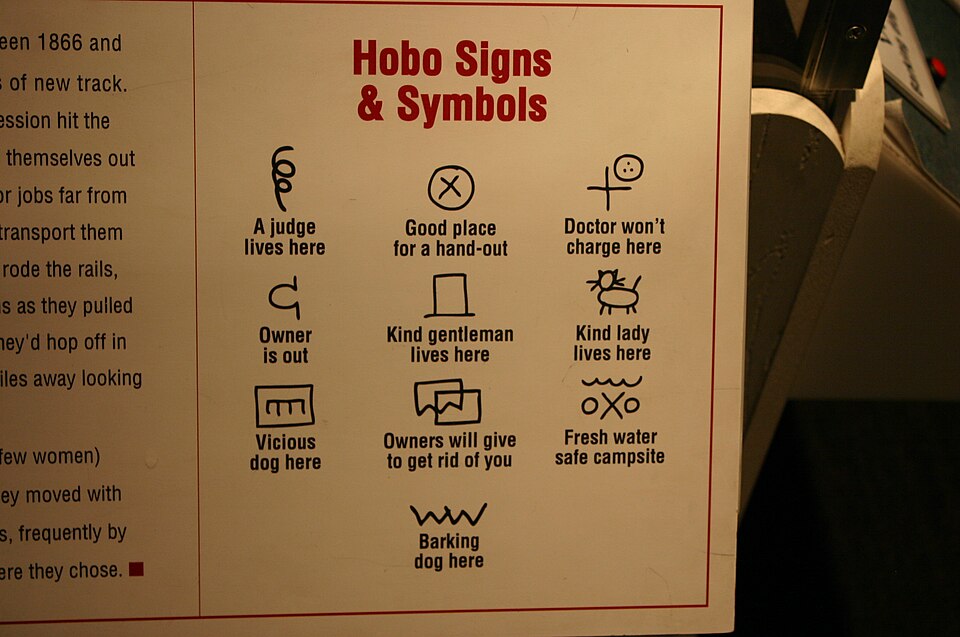
Hobo signs and symbols - A visual language carved, drawn, or marked to communicate warnings and information along the rails.
This glossary preserves some of the language of the road, captured in photographs, interviews, and historical documents from the 1890s through the 1950s.
Hobo
HOH-boh
A migratory worker who rides the rails seeking employment. Distinct from a "bum" (doesn't work) or a "tramp" (won't work). A hobo is fundamentally a working person on the move.
"I'm not a bum, I'm a hobo. I work when I can find it."
Jungle
JUN-gul
A camp where hobos gather, typically along a river or railroad. Jungles had unwritten rules, shared food (hobo stew), and communal fires. A good jungle was a lifesaver; a bad one could get you killed.
"There's a safe jungle down by the river. Good people, good stew, and the bulls don't come around much."
Bull
BOOL
A railroad police officer or security guard. Bulls were feared—they would beat hobos, arrest them, throw them off trains. Knowing where bulls patrolled was essential information.
"Watch out for the bulls in the rail yard. They've been mean lately."
Riding the Rails
RY-ding the RAILS
Traveling by catching freight trains without paying. The primary mode of transportation for hobos. Required knowledge of which trains were safest, where to board, and how to avoid bulls.
"I've been riding the rails for five years now. Seen most of America from a boxcar."
Bindle
BIN-dul
A bundle carried by a hobo, typically tied to a stick and slung over the shoulder. Usually contained clothing, bedroll, and meager possessions. The iconic image of the traveling hobo.
"Grab your bindle and let's head to the next town. There's work at the harvest."
Mulligan Stew
MUL-i-gun STEW
A communal stew made in hobo jungles, created from pooled ingredients—vegetables, meat scraps, anything edible. The heart of jungle community. Each person contributed what they could.
"The jungle's making mulligan stew tonight. Everyone eats. No one goes hungry."
Flop House
FLOP HOWS
A cheap boarding house, usually in the poorest part of town. A flop offered a bed for a night or two when a hobo had money. Better than the jungle, but often dirty and dangerous.
"I had a dollar, so I spent the night at the flop instead of the jungle."
Gink
GINK
A hobo who doesn't follow the code. Someone selfish, violent, or untrustworthy. Being called a gink was serious—it could get you thrown out of a jungle or worse.
"That guy's a gink. Don't trust him. He'll steal from you soon as look at you."
Bindle Stiff
BIN-dul STIFF
A seasonal laborer who travels with a bindle looking for work. Often lumberjacks, harvest workers, or construction workers. Similar to hobo but with more emphasis on labor.
"The bindle stiffs are coming in for the harvest. There'll be good work for a few months."
Moniker
MAH-ni-ker
A hobo's name or nickname, often used instead of real name. Many hobos were known only by monikers—Silent Pete, Kansas Joe, Freight Train Kate. Your moniker was your reputation.
"What's your moniker, friend?" "They call me Dusty Jim."
The Road
The ROHD
Life as a hobo, traveling and working. "The Road" was both literal (the rail lines, the highways) and spiritual (a way of life, a philosophy).
"I've been on the Road for ten years. Don't think I could stay in one place anymore."
Yegg
YEG
A hobo who engages in theft or crime. Distinguished from hobos who worked. Yeggs were feared and often expelled from jungles.
"That yegg robbed three men last month. Don't let him near your camp."
Punk
PUNK
A young, inexperienced hobo. Often taken under the wing of older hobos who would teach them the rules of the road, where to find work, how to avoid bulls.
"That punk's new to the Road. I'll teach him how to survive."
Hardtack
HARD-tak
Cheap, hard biscuit—common trail food. Difficult to chew but long-lasting. Essential for traveling light.
"We're carrying hardtack and jerky. It's not much, but it lasts."