
Employment sharks chalk wages on a Madison Street window. A man reads the board, buys a flop, and waits for a “ship”—a job with a ride thrown in. The street is the stem; the stem is home for a day.
Harvest circuits ended in cities. Every large American rail town grew a strip where migratory workers found cheap beds, cheap food, cheap drink, employment agencies, missions, and each other. Riders called it the main stem. Chicago’s was the most famous—and the best documented. This room maps Hobohemia as urban geography: West Madison, other stems, Seattle’s Skid Road, Minneapolis’s Gateway, and what Nels Anderson’s 1923 ethnography still lets us verify.
Chicago’s West Madison “slave market”
Nels Anderson’s The Hobo (1923)—University of Chicago fieldwork among homeless men, building on his own road years—fixed the vocabulary for scholars and for this museum. Hoboes called West Madison the Main Stem; newspaper writer Harry M. Beardsley, quoted by Anderson, called it the Rialto of the hobo. To men looking for work it was also the “slave market”: employment agencies (“sharks,” “man catchers”) sold distant jobs with transportation attached. Anderson’s opening chapters describe young and middle-aged men reading chalked window bills, preferring a far job that moved them over a local wage that kept them still.
The Encyclopedia of Chicago’s “Hoboes” entry summarizes the classic West Madison stem from the Chicago River toward Halsted: inexpensive restaurants, saloons, flophouses, employment agencies; a segregated South State strip for Black transients; free-speech forums such as Bughouse Square and the Dill Pickle Club where Wobblies and soapboxers mixed with artists. Warm months spilled into park “open-air hotels” and jungles behind the Field Museum. Authorities in the 1910s estimated hundreds of thousands of transients passing through Chicago in a year, with tens of thousands present on a given day—order-of-magnitude figures Anderson and city agencies both used, not a census. By mid-century, as migratory labor demand fell and Skid Row language hardened, West Madison’s stem shade shifted toward a more stationary homeless geography—still related, not identical, to the harvest-circuit hobo of 1910.
Other American stems
Anderson stressed that every large city had a stem. Secondary syntheses and rider memory name South Main in Los Angeles, Third Street in San Francisco, the Bowery in New York, Pratt Street in Baltimore—local names for the same toolkit: flop, mission, shark, saloon. This museum does not invent a census of every strip; it insists the pattern was national and that Chicago remains the best-archived case because Anderson, Reitman, the IBWA’s Hobo College, and Chicago’s rail volume all left paper.
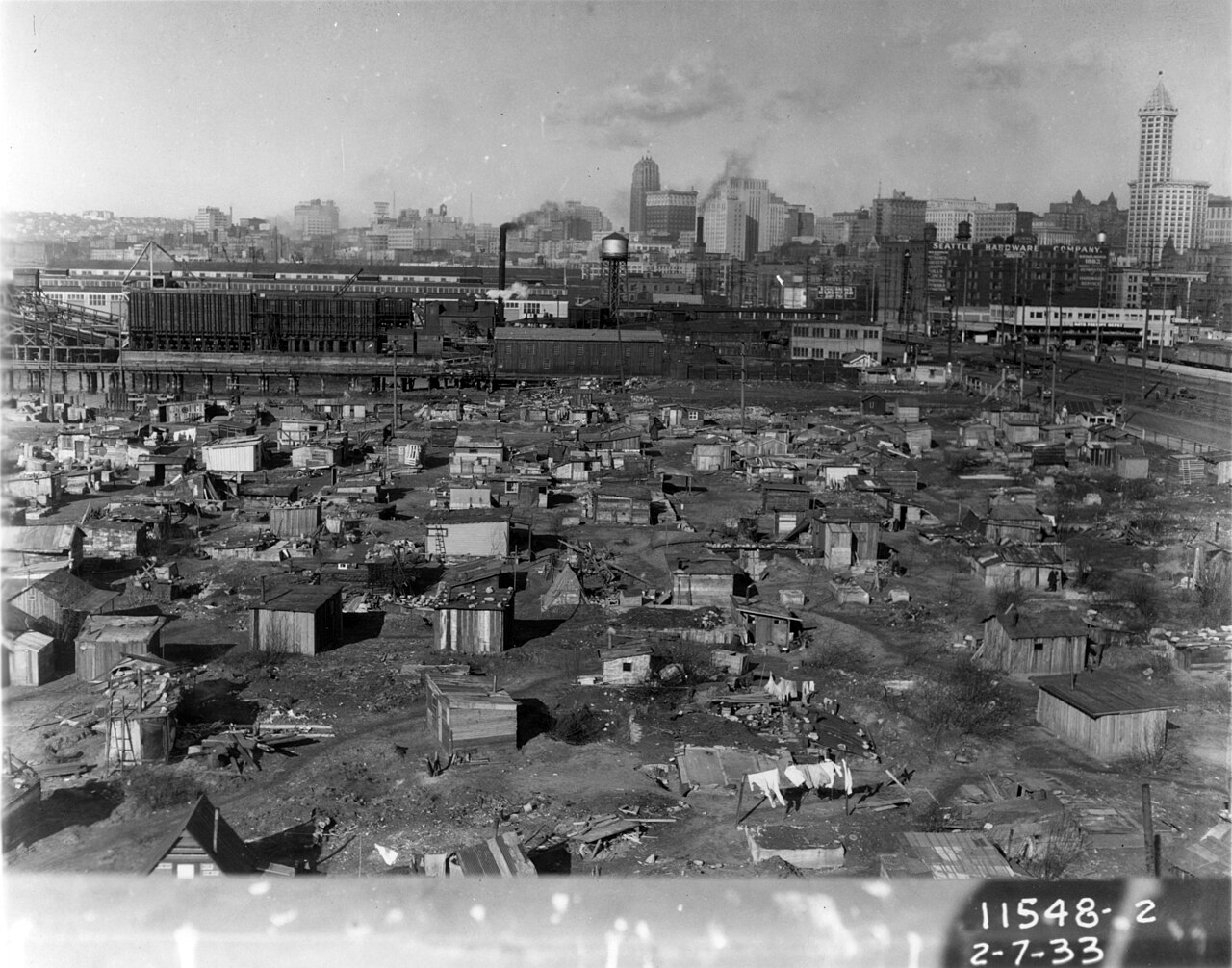
Seattle’s Skid Road is etymology as well as geography. Yesler Way took its nickname from logs skidded downhill to Henry Yesler’s waterfront mill; “Skid Road” later generalized into “Skid Row” for down-and-out districts nationwide. Depression-era Seattle also grew a large Hooverville on former shipyard tide flats beside the waterfront—hundreds of shacks documented in Seattle Municipal Archives photographs (including the February 1933 view below) and studied by contemporary observers. Treat Skid Road / Hooverville as Pacific Northwest chapters of stem and shanty geography, not as Chicago’s Madison twin in every detail.

Minneapolis’s Gateway district—near the Milwaukee Road and other depots—functioned for decades as that city’s skid-row / labor-exchange neighborhood for seasonal and transient men (local historic designations and Gateway-district histories). Pair it with Anderson’s warning that stems were home for a day: friends and enemies until the next ship. John Vachon’s FSA Minneapolis plates of jungle cooking (treated more fully in the jungle room) show the Twin Cities’ outdoor edge of the same migratory world.
Why the stem matters here
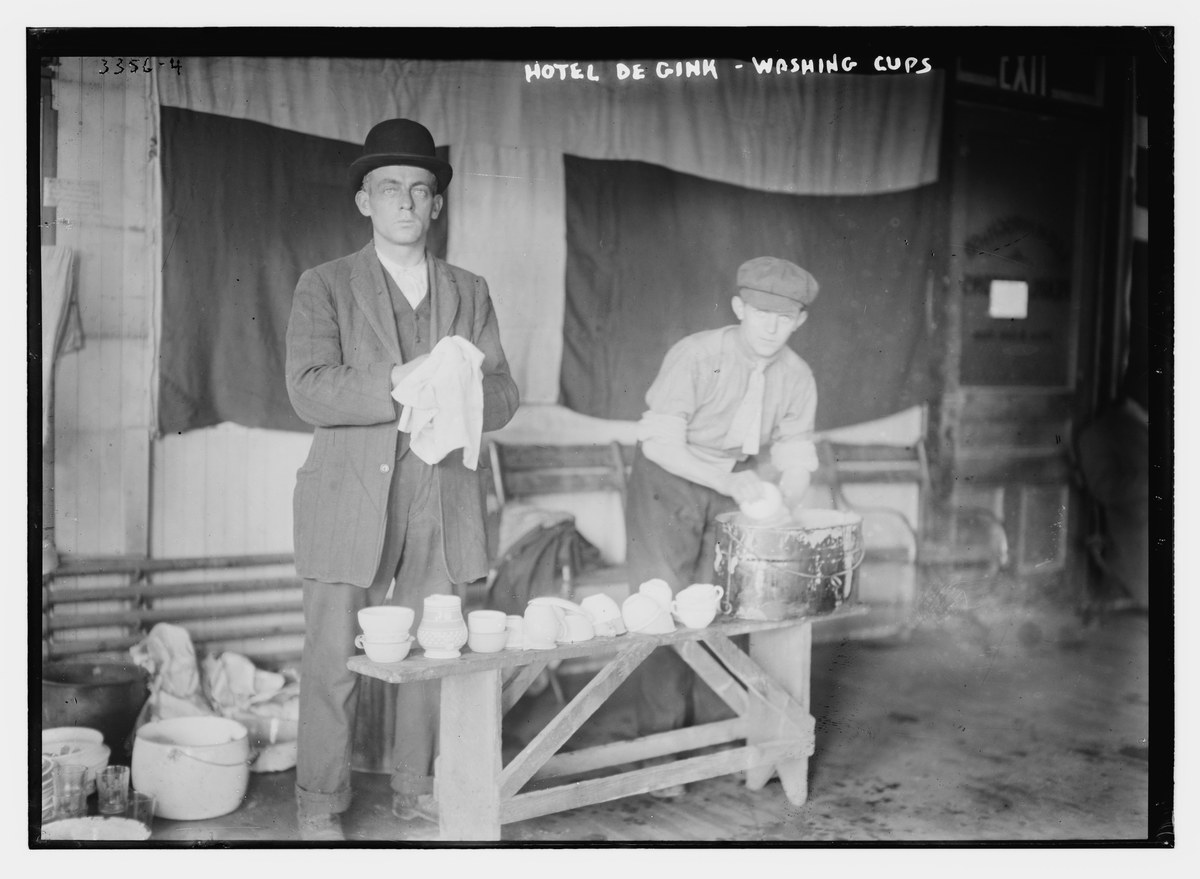
Work circuits explain where wages called. Hobohemia explains where the waiting happened—the urban hardware of migratory labor. Hobo College sat on Chicago’s stem; missions and flops fed the same blocks; IWW and IBWA organizers competed and overlapped in those halls. Hotel de Gink–style lodging made mutual aid visible; Hoovervilles showed what happened when the circuit jammed and the city filled with men who could not ship out.
That closes the urban end of The Road wing. The next corridor asks who rode—writers, women, Black travelers, Depression youth—and lets some of them speak.
See Sources for works and archives cited in this room.